Farmers Are Installing Solar Panels. Both Crops Are Thriving
Agrivoltaic installations are producing more electricity and better yields on the same acre. The land-use conflict may be overstated.
The pushback against utility-scale solar has always had a land-use dimension. Taking productive farmland out of agricultural production — permanently, at least for the 25 to 30 year project life — generates real opposition from farming communities and from policymakers who worry about food security. It is not an unreasonable concern. The US has already lost millions of acres of agricultural land to development over the past century.
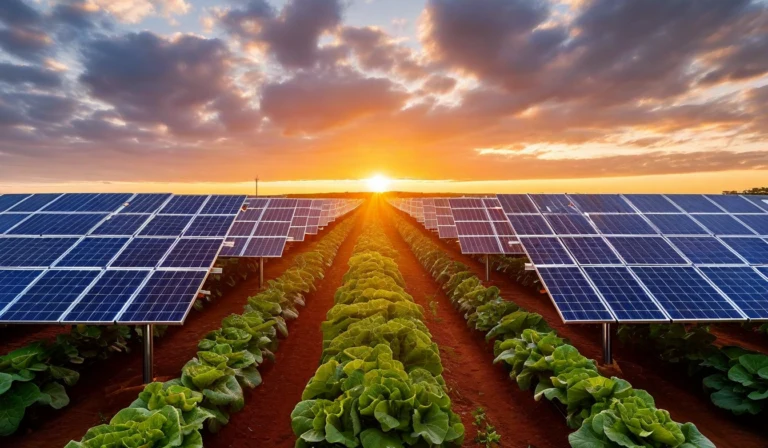
Agrivoltaic systems — solar panels mounted at sufficient height above farmland to allow continued crop production underneath — have been quietly dismantling that conflict for about five years. The data is now robust enough to take seriously. In our diligence on Strata Solar, which we backed in their Series C, we reviewed results from over 40 operational agrivoltaic sites across the Southwest, Midwest, and Mountain West. The findings are not what we expected, and they are not marginal.
What the Yield Data Actually Shows
The intuitive concern is that solar panels reduce the sunlight available to crops. That is true — but it turns out many crops do not want full direct sun all day, particularly in high-irradiance regions. Partial shading can improve yields for leafy vegetables, berries, and certain grain crops by reducing heat stress and water evaporation. In arid western states, this effect is substantial.
A long-running trial at the University of Arizona found that cherry tomatoes, chiltepin peppers, and jalapenos produced under agrivoltaic panels showed yields 3 to 5 times higher than control plots. Soil moisture was 15 percent higher under the panels. Irrigation demand dropped by roughly a third. In a region where water is the binding constraint on agriculture, that last number matters more than the solar output.
Not every crop works. Row crops like corn and soy that are already optimized for full sun exposure and mechanized harvesting present real challenges — both agronomically and operationally — under elevated panel structures. The current agrivoltaic sweet spot is perennial crops, specialty vegetables, and pasture for sheep grazing (which several installations now use for vegetation management, eliminating mowing entirely).
The land-use conflict between solar and agriculture is real in some configurations and essentially absent in others. The question is which crops and which regions. That is a solvable problem — it just requires more site-specific design work than a standard ground-mount installation.
The Economics for Landowners
For farmers, the financial structure of an agrivoltaic installation differs significantly from a standard solar land lease. In a standard lease, the farmer gives up productive use of the land entirely in exchange for a fixed rental payment — typically $500 to $1,500 per acre per year, depending on region and solar resource quality. With agrivoltaics, the farmer retains agricultural income, and the solar component either takes a similar per-acre lease structure or, in some models, a revenue-sharing arrangement that aligns incentives more directly with generation performance.
The combined income stream — lease payments plus continued crop sales — substantially improves farm economics in many cases. We have seen pro forma models where agrivoltaic income lifts a marginally profitable small farm to comfortably profitable without requiring any change in the farming operation. For farmers under financial pressure, that is not a trivial consideration.
Policy Tailwinds and Developer Challenges
The USDA's Partnerships for Climate-Smart Commodities program has provided grant funding to agrivoltaic demonstration projects, acknowledging the soil health and water conservation benefits as climate-smart agriculture practices. Several states — including Colorado, Massachusetts, and Minnesota — have created incentive programs or mandate set-asides that specifically support agrivoltaic development. Net metering and community solar program eligibility have also expanded to cover agrivoltaic systems in most markets.
The developer challenges are real. Agrivoltaic installations require more complex structural engineering to support panels at working height (typically 8 to 14 feet above grade), which increases installed system cost by 15 to 25 percent compared to standard ground-mount. Project development requires genuine agricultural expertise — both to design for specific crop types and to maintain farmer relationships over a decades-long project life. These are not trivial operational requirements. Developers who treat agrivoltaics as just another solar install with higher racking costs typically underperform.
Why This Matters for the Solar Build-Out
The scale of solar deployment required to meet US decarbonization goals is genuinely large. Most estimates put it in the range of 700 to 1,000 GW of additional utility-scale solar by 2035. At typical solar park densities, that requires on the order of 5 to 7 million acres of land. The US has about 900 million acres of farmland. The math is not actually that threatening — less than 1 percent of US farmland would need to host solar to meet those targets. But the political reality of siting is more difficult than the math suggests.
Agrivoltaic systems reduce the perceived conflict between solar development and rural communities who depend on the agricultural economy. They give farmers a reason to support solar projects rather than oppose them. And they produce more watts per acre than panels sitting idle between rows of crops. That combination — better community acceptance, better land use — is worth the additional installation cost.
We expect agrivoltaic specifications to become standard practice for solar development on agricultural land within five years. The data supports it. The economics support it. And frankly, the farmers we have spoken to who have been through both types of installations prefer the model where they still get to farm.
Continue Reading