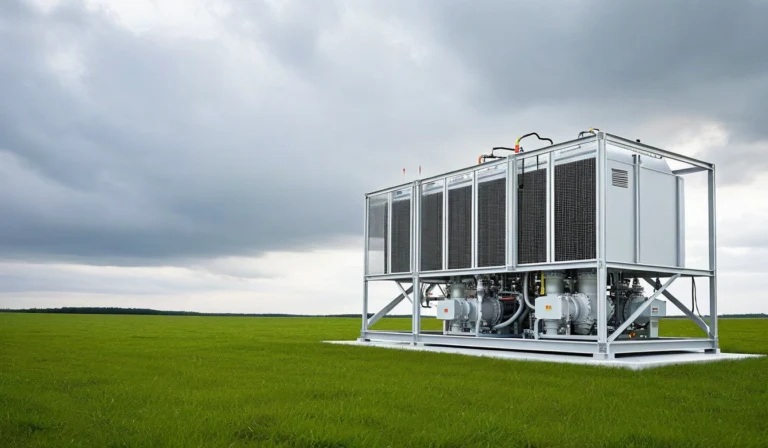
Storing Hydrogen in Solid Form: Why Now
Compressed and liquefied hydrogen have real safety and cost limitations. Solid-state storage addresses both — and the materials science is finally there.
Hydrogen has an energy density problem that gets glossed over in a lot of the enthusiasm around the hydrogen economy. On a mass basis, hydrogen is extraordinary: about three times the energy density of gasoline by weight. On a volume basis, hydrogen at ambient pressure is nearly useless — a kilogram of hydrogen gas at standard conditions occupies 11 cubic meters. That is not a tank. That is a room.
The conventional solutions are high-pressure compression (storing hydrogen at 350 to 700 bar in reinforced cylinders) and cryogenic liquefaction (cooling hydrogen to -253 degrees Celsius). Both work. Both have serious drawbacks that limit where hydrogen can be used economically and safely.
The Problems with Compression and Liquefaction
Compressed hydrogen at 700 bar requires extremely thick-walled, heavy cylinders made from carbon fiber composites — expensive to manufacture and difficult to scale for stationary applications. The compression energy cost is real: compressing hydrogen from ambient to 700 bar consumes roughly 10 to 15 percent of the stored energy content. That efficiency loss adds up over a system lifetime. And the safety implications of storing large quantities of compressed flammable gas at extremely high pressure require significant engineering controls.
Liquefaction is even more energy-intensive. Cooling hydrogen to liquid requires about 30 to 40 percent of the energy content of the hydrogen itself — a substantial parasitic load. Liquid hydrogen also boils off continuously in even well-insulated tanks, making it unsuitable for applications where hydrogen sits unused for extended periods. The fill infrastructure requirements — specialized cryogenic dispensing equipment — limit the locations where liquid hydrogen can practically be deployed.
The storage bottleneck is what limits hydrogen from being a versatile energy carrier. Fix the storage problem and the mobility and backup power applications become dramatically more accessible. That is the bet behind solid-state hydrogen.
What Solid-State Storage Actually Is
Metal hydride and chemical hydride storage materials absorb hydrogen into their crystalline structure at moderate pressures, then release it when heated. The hydrogen is stored at near-ambient pressure — the material is essentially a sponge for hydrogen molecules. Gravimetric storage densities for the best current commercial materials run around 1.5 to 2 percent by weight (hydrogen mass as a fraction of total system mass), with laboratory demonstrations of metal organic framework materials showing 5 to 7 percent.
The practical advantages are significant. Tank pressure is typically below 50 bar rather than 700 bar — a fundamentally different safety profile. There is no boil-off: hydrogen stays in the material until heat is applied to release it. The energy cost of loading and unloading, while not zero, is lower than either compression or liquefaction for most use cases.
The current limitation is gravimetric density. At 1.5 to 2 percent by weight, the system mass for a given hydrogen storage capacity is higher than compressed tanks. For mobile applications where every kilogram matters, that is a significant disadvantage. For stationary backup power applications — where you are not moving the tank — it is often irrelevant.
Why the Materials Science Has Moved
Three things have changed over the past five years that make solid-state hydrogen storage more commercially viable now than in the period of peak interest around 2008 to 2012, when the technology attracted significant attention and then largely failed to commercialize.
First, the catalyst materials that control loading and unloading kinetics have improved substantially. Earlier metal hydride systems had poor rate performance — they loaded and released hydrogen slowly, limiting power output. New catalyst formulations have cut charge and discharge times by 50 to 70 percent, making them viable for applications that need power on demand rather than just continuous low-rate supply.
Second, manufacturing costs have declined. The metal hydride alloys used in commercial systems are primarily titanium, iron, and manganese — abundant materials whose supply chains are well-established. The manufacturing complexity has been engineered down through better understanding of material formulation and processing.
Third, the application landscape for hydrogen has clarified. The clearest near-term markets for solid-state storage are backup power systems for critical infrastructure — telecommunications towers, data centers, hospitals — where compressed hydrogen safety concerns limit deployment in occupied buildings, and where the no-boil-off characteristic is operationally essential for equipment that may sit idle for months between use events.
The Investment Logic
Nexgen Hydrogen, our seed portfolio company in this space, is targeting exactly that backup power market. The comparison set for their product is not fuel cells powered by compressed or liquid hydrogen — it is diesel generators and lithium-ion battery backup systems. Against diesel, the operating cost advantage is clear where hydrogen supply is available. Against lithium-ion, the energy density advantage matters for applications requiring more than four to eight hours of backup duration.
The hydrogen supply question is real: solid-state storage only makes sense in locations where hydrogen is available at reasonable cost and with reliable logistics. That market is smaller today than it will be in five years as hydrogen distribution infrastructure builds out. But the backup power market exists now, in locations adjacent to industrial hydrogen users, and it is large enough to support commercial-scale business development while the broader infrastructure matures.
Storage is always the bottleneck for any energy carrier. Solving it — even partially, even for a specific set of applications — unlocks a market that does not currently exist. That is the kind of problem we like.
Continue Reading